




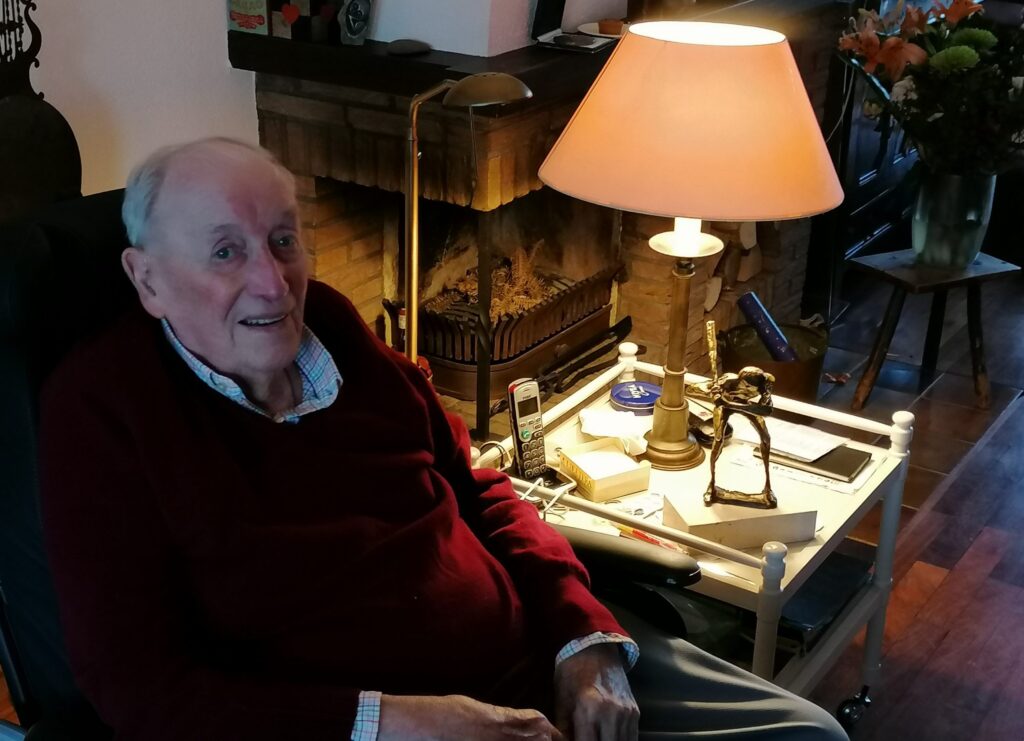
“To tell the story of that first Haarlem Baseball Week, we need to start with a little background.” With these words, former Baseball Week chairman Wim Oosterhof begins at his home in Haarlem, just a stone’s throw from the Pim Mulier Stadium. We go back to 1956, when the Dutch baseball team participated in an international baseball tournament for the first time. The players were initially received like royalty in Rome. That changed when those newcomers suddenly proved to be formidable competitors.
In fact, the Dutch team was simply too strong for their hosts, and they weren’t exactly appreciated for it. Oosterhoff was already there in Italy at the time and looks back with a smile on how the mood shifted. “Suddenly, we were no longer allowed to use the same facilities. Subsequently, the Italians refused to come to Haarlem for the first Baseball Weeks, because they didn’t want to reveal the balance of power too clearly.”
Thanks to the efforts of Wout Posthema, the then-new president of the KNHB, the baseball circus came to Amsterdam two years after the European Championship in Rome. “Baseball was fortunate that people like Bob Spaak and Dick van Rijn, at the time the country’s most popular sports reporters, were enthusiastic about the sport. The final of the 1958 European Championship was even broadcast live on television.” It wasn’t just on television that baseball games were closely followed. The stands were also packed during the tournament with people eager to experience the spectacle up close. The fact that those stands and the baseball field could be set up was thanks to KNHB chairman Posthema. He managed to secure the use of OVVO’s soccer fields and ensured they were quickly restored to playable condition for soccer after the tournament concluded.
After four consecutive European titles—as the Dutch national team had also proven itself the best in Mannheim (’57) and Barcelona (’59)—the Dutch team seemed to have outgrown its own continent. With the successful hosting of the European Championship on home soil still fresh in everyone’s memory, there was a growing need for a regular international tournament on Dutch soil. In 1961, that desire gave rise to the first edition of the Haarlem Baseball Week.
Although the European Championship was held in Amsterdam, Haarlem was the undisputed baseball capital of the country at the time. The city was home to no fewer than five baseball clubs and thus seemed the most promising place to organize an international tournament. “Gé Hoogenbos did everything in his power at the time to bring the tournament to Haarlem,” Oosterhof recalls. “A few aldermen were also open to the idea of an international sports tournament in Haarlem, but the organization had to be in the hands of an experienced committee. That’s how they ended up coming to us, the board of the annual Haarlem Sports Weeks.”
There was no money available at the time. Attention turned to American soldiers stationed in neighboring countries after World War II. Ron Fraser, the American coach of the Dutch team, had served in West Germany and had maintained contacts throughout Europe as a result. Teams traveled to Haarlem for that first Baseball Week from Chateauroux (France), Alconbury and London (England), Wiesbaden and Mannheim (West Germany).
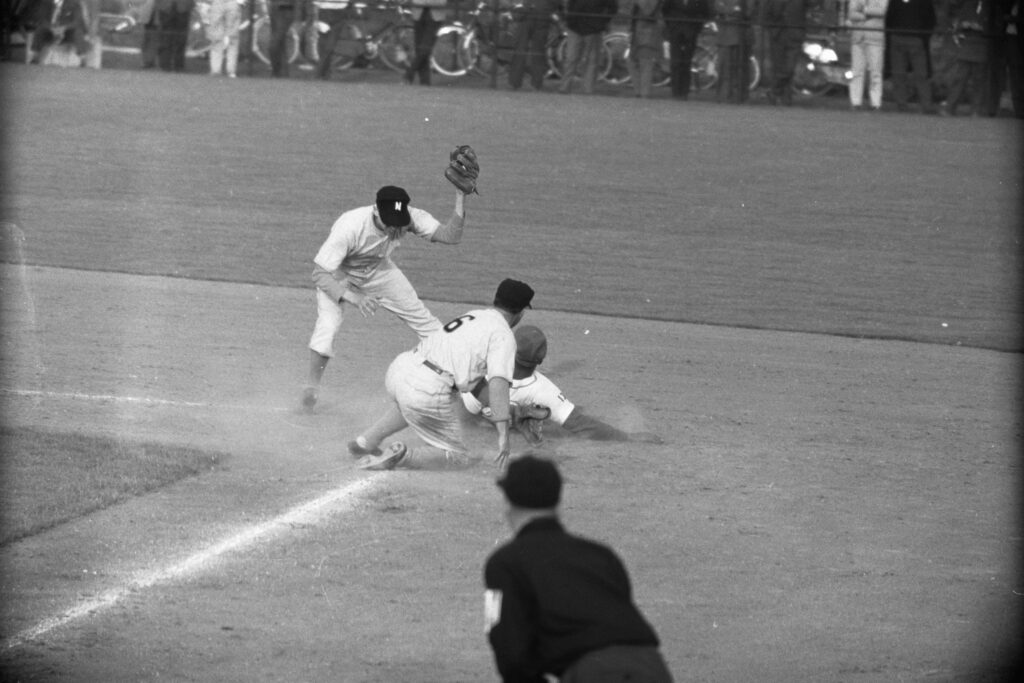
The Americans proved to be a different breed from the European baseball players whom the Dutch team had so easily defeated in recent years. The Dutch squad, which competed in that first edition under the name “Kieviten” because the federation did not allow them to play as the national team, finished fifth out of six. They managed to finish ahead of only the London team that year. Nevertheless, this first baseball week was a huge success. The public turned out in droves for the event and were amazed by what they saw. The Americans’ fielding and athleticism made a big impression.
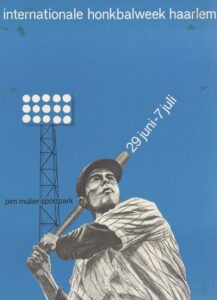
For the second edition two years later, the tournament moved from the temporary field on Badmintonpad to the newly constructed Pim Mulier Stadium. “[Construction company] Nelissen built that stadium from the ground up in 88 days.” It was the first baseball stadium in Europe. The new facility also featured a full lighting system, allowing games to be played under artificial light in the evenings. The tournament had finally found a venue worthy of the event.
Looking back on those early days, the name Bob Sullivan—a furniture millionaire from Grand Rapids, Michigan—quickly comes to mind. “Sullivan was a true baseball fan. He really saved the organization’s skin a few times in later years. If teams canceled at the last minute, we could always call him.” Especially when the Cubans pulled out just before the start of the tournament in ’78, everyone in Haarlem was at a loss. A phone call to Sullivan provided the solution. He scrapped his plans and sent his team on the first flight to the Netherlands.
Oosterhof also has fond memories of the guest tent. “Mrs. Weijland, who handled the catering for Haarlem Nicols, used to make the sandwiches there. You’d always get a slice of gingerbread with them. That’s where the coaches, referees, sponsors, and officials all gathered. It really created a special bond. Now everyone’s in their own box. Gerard Voogd was the key figure in the organization from the very beginning. He brought in both teams and sponsors. Back then, a lot of bigwigs came to Haarlem. Top executives from Philips and Coca-Cola were more than happy to associate themselves with the tournament.”
Thanks to Baseball Week, Oosterhof also met the love of his life. During preparations for the second edition, several council members involved assigned their secretaries to the organization. One of those secretaries was Hennie, to whom Wim has now been married for more than fifty years. While their first collaboration had resulted in nothing more than a friendship, something beautiful blossomed during their second collaboration a few years later.
Suddenly, Wim—who until then had always driven to the meetings at Gerard Voogd’s house—showed up on his bike, so he could ride there with Hennie.
Text: Sander Grasman