




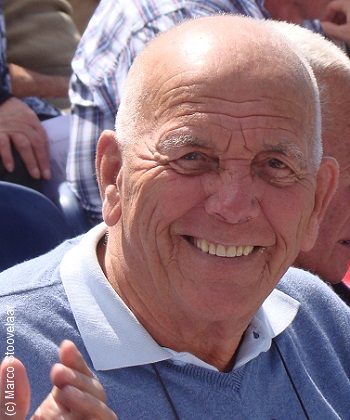
Han Urbanus, who played in the big league in four decades, threw 11 No-Hitters and played 17 years for the National Team, died on Friday (Feb. 5) at the age of 93. With the Dutch Baseball Team, Han Urbanus won seven consecutive European titles. Urbanus also participated in Major League Spring Training with New York Giants, was a member of the Dutch Hall of Fame and was a living legend and a Dutch baseball icon.
Johannes Hendrikus Urbanus was born on June 22, 1927 in Rotterdam. Han Urbanus was the younger brother of Charles Urbanus, who was also born in Rotterdam in 1914. When Han was about seven years old, the Urbanus family moved to Amsterdam in the early 1930s. It was there that the two Urbanus brothers became closely involved with OVVO, where they initially played soccer. When OVVO established a baseball department on Jan. 1, 1935, Charles also started playing baseball. At age 11, Han accompanied his older brother to a baseball practice. He fitted a glove, started throwing some balls and the rest in history.
Charles Urbanus became a base player on OVVO’s main squad and played for the team until the early 1960s. By then he had focused more on coaching, and in the final years of his playing career he led the Amsterdam team as a player/coach.
Han Urbanus became a pitcher early on. The right-hander made his debut on OVVO’s team in 1946 when the team was promoted to the top division. A year later (1947), OVVO played for the first time in the First Division (then the highest division). That was the beginning of a very successful period for both the club and the Urbanus brothers.
In 1949, OVVO captured the championship title for the first time. After this, the team also took the title in the next four years. With this, OVVO became the first team in Dutch baseball history to become national champions in five consecutive years.
Other players from OVVO in those early years, besides the Urbanus brothers, were Gerrie Altink, Hans Boersma, Hennie de Lugt, Frits Meijer, Arie Pieneman, Co Roozendaal, Nico Tuinder, Theo van der Walle and Simon Weij.
In later years, Han Urbanus’ teammates at OVVO included Jan Bruning, Flip le Cuivre, Aart Kruijs, Hennie Regeling, Max Rietbergen and Martin Rosenkrantz.
From the beginning, Han Urbanus was one of those pitchers who threw a whole game, no matter what the score was. After gaining experience in his first two seasons in the top division (1947-1948), Han Urbanus began to dominate from 1949. Not only did he throw a complete game every week, he very regularly struck out 10 or more batters in a game.
In OVVO’s first big league season (1947), the team did not start well, losing its first six games. But on June 22, OVVO won 11-5 over Haarlem-based EDO. Han Urbanus pitched a complete game, allowed only three base hits, struck out 13 and earned his first victory.
In the 1949 season, he led OVVO to its first championship title and was the winning pitcher in 10 of the 14 games the team played. Twice a game ended in a draw. Unfortunately, there are no official statistics for those seasons, but in the 1949 season Urban had at least 191 strikeouts. In his career as a pitcher, his estimated number of strikeouts exceeds 1,900. With that, he was the all-time record holder for a long time. In the 1949 season, Urban twice struck out 20 in a game, both times against Blue-White, which was then one of the top teams. Remarkably, Urban accomplished these feats while also serving in military service that year. He was stationed at Vught in Brabant. In the evenings, he led training sessions at southern clubs PSV, Longa and Pacifico. And on weekends, he traveled to Amsterdam to be with OVVO.
Urbanus underscored his strength as a pitcher in the 1949 season by throwing the first of his 11 No-Hitters, including a record nine for OVVO in the highest division. In those years, the Dutch Baseball Team played annual games against Belgium, usually both home and away. On June 19, 1949, Urbanus made his debut on the Dutch Team and was the winning pitcher in a 6-4 victory in a game played in Antwerp, Belgium. In this game, he formed a duo with Frits Meijer, who was also his catcher at OVVO. Less than two months later, Urban returned to the mound for the Orange when they played against Belgium in Rotterdam on Aug. 7. At Sparta Field, the Netherlands rallied to a 14-0 shutout against the Belgians. Urbanus pitched the entire game, had 10 strikeouts and threw a No-Hitter.
Han’s brother Charles was the third baseman in the first game and the shortstop in the second. Other players on the Dutch Team during these two games were Teun Gaartman, Joop Geurts, Trinus Holewijn, Gé Hoogenbos, Frits Meijer, Joop Nusse, Joop Odenthal, Wim Prins, Jan Smidt and Cor Wilders. Jan Smidt, also a strong pitcher, played in the infield in these two games.
Two years later, on June 24, 1951, Urbanus threw another No-Hitter as pitcher of the Dutch Team against Belgium in Amsterdam in the first of two meetings that year. The game, played at Ajax’s soccer stadium, was won 6-0. Geurts, Holewijn and Hoogenbos also played again for Orange, as did players such as Piet Duinker, Martin Jole, Henk Keulemans and Hennie de Lugt.
As mentioned, Han Urbanus dominated as a pitcher in the highest division from 1949, as did his team OVVO. In the 1950s there were attractive matches when OVVO faced such strong teams as HHC, Schoten, Blauw-Wit, VVGA, EHS and Sparta (which debuted in the top division in 1955). When these teams faced each other, the many spectators were assured of an attractive game with good hitting and especially strong pitching. In those years, there were several pitching duels between Han Urbanus and Jan Smidt (HHC), Nico Brands (VVGA), Joop Schuitemaker (EHS) and Jaap de Koning. In 1959, a player debuted on VVGA’s team and also became a mound legend: Herman Beidschat, who went on to play for EHS a year later.
Over the years, it was always said that the hill-rivalry between Han Urbanus and Jan Smidt was the longest and most attractive, as the two were evenly matched. A few years ago, Smidt stated that he always enjoyed these games. ”I loved those meets, but Hannie was simply the better pitcher. He was just the best player in everything,” Smidt said in an interview with the author of this story a few years ago.
On July 7, 1951, two weeks after his second No-Hitter as an Orange pitcher, Han Urbanus threw his first No-Hitter in the highest division for OVVO. On that day, OVVO played an away game at VVGA in what became a pitchers’ duel, as both Urbanus and VVGA pitcher Johnny Hoitzing did not allow any runs. OVVO won 1-0 and the only run was scored in the ninth inning on a bad-hop single by Han’s brother Charles Urbanus.
Two years later, Han Urbanus threw his second No-Hitter in the upper division. On August 16, 1953, OVVO played at VVGA again, this time winning 3-0. With the win, OVVO became champions of the A Pool. Because the top division consisted of two pools that season, OVVO had to take on the winner of Pool B after the season in a game attended by thousands of spectators at the neutral field of Zeeburgia in Amsterdam. The opponent was HHC, resulting again in a duel between Urbanus and Smidt, both of whom only allowed one base hit! OVVO won 2-0 (on a few errors) and captured their fifth consecutive championship title.
Starting in 1954, Han Urbanus would throw seven more No-Hitters to become the all-time record holder with nine! A record that will never be broken! Urban twice threw two No-Hitters in one season (1954, 1956). Jan Smidt threw four No-Hitters in his career.
Urban threw his ninth and final No-Hitter on Aug. 13, 1961. At that point in his career, the then 34-year-old Urbanus had more or less traded his spot on the mound for a position in the infield, primarily as a second baseman. However, in the 1961 season he made a return to the mound and showed that he was still one of the best (perhaps the best) pitchers. On the said date, Urban came to a 2-0 shutout against Schoten and almost became the first game in history with a Perfect Game. However, one Schoten batter managed to reach base. That was Gerrit Nanne, who walked in the sixth inning.
Han Urbanus was not only a great pitcher, he was also good with the bat. He was a solid hitter with power and frequently hit a home run. This made him a very all-round player who was of great value for not only his club OVVO, but also the Dutch Team.
Han Urbanus was voted Best Pitcher five times in his long and impressive career. He won the award three times in a row, 1953, 1954, 1955, and then again in 1957 and 1958. In between (1956), Jan Smidt was the Best Pitcher. Urban led the league in strikeouts in 1955 with 213, which was the highest postwar number since Roel de Mon had provided a record with 225 in 1940. It took until 1980 for the total of 213 strikeouts to be matched. In that season, American left-hander Craig McGinnis also reached 213.
Urban was the Most Valuable Player three times. In 1954 and 1955 he was voted Best All-Rounder (the precursor to the MVP award), then was Most Valuable Player in 1961 in his comeback season as a dominating pitcher. In 1959, Urban was Best Hitter with a .348 batting average.
Han Urbanus played in the highest division in four decades (1947-1970). His 24 big league seasons (for one club) were long a record.
After his debut on the Dutch Team in 1949, Han Urbanus was a member of the team through 1965. In the early years of his Orange tenure, only annual games were played against Belgium. The team also sometimes played against American teams from military bases located in what was then West Germany.
In 1956, the Dutch Team participated in the European Championship for the first time. Led by player/coach Henk Keulemans, the team captured the title at the event played in Rome, Italy. This was the first of seven consecutive European titles through 1965. During these seven ECs, the Dutch Team remained undefeated! Han Urbanus was an important player during all these tournaments, first as a pitcher and later, in the 1960s, as an infielder and power hitter. Two of these titles were won in front of their own audience, as the European Championships were held in Amsterdam in 1958 and 1962. A temporary stadium was erected on the field of OVVO, the club of the Urbanus brothers, and the Netherlands won the title.
It was during these years that the European rivalry between the Netherlands and Italy began to take shape. The Netherlands won from the Italians each time during these seven Championships. However, the matches between them were always interesting, no matter what the result was, because it meant a hill-climbing encounter between Han Urban and Italian legend Giulio Glorioso.
In 1956 and 1957, the winner of the European Championship also qualified for participation in the Global World Series later in the year. And so the Netherlands traveled to the USA in 1956 (Milwaukee) and 1957 (Detroit) to play against Puerto Rico, Colombia, Venezuela and Canada. These were the first international matches against teams from outside Europe, and it became clear that these teams were too strong. The Netherlands lost all their matches during these two events, but the players gained tremendous experience by not only playing against these teams, but also participating in such an event. It was agreed before the start that the players who played for the team that captured the European title in 1956 and 1957 would also travel to the USA.
Nico Brands, Joop Geurts, Martin Jole, Henk Keulemans, Herre Kok, Henk Lukkien, Jan Smidt, Han Urbanus and Dolf de Zwart participated in both Global World Series. Also playing in 1956 were Gé Hoogenbos, Ruut Jongeling, Frans Klooster, Ruud Kok, Frits Meijer, Harry Nijhuis and Charles Urbanus. And in 1957, the team further consisted of Joop Bakker, Nol Houtkamp, Leo Kops, Henny van Lieshout, Piet de Nieuwe and Henny Regeling.
In 1961, Holland made another trip to the USA. This time a series of games were played against the semi-professional team of the Sullivans in Grand Rapids, Michigan. Han Urbanus was also part of the team then, but this time as an infielder. The pitchers were Herman Beidschat, Nico Brands, Bobo Echobardo, Jan Smidt and Ruud Zijlstra. The team was led by Ron Fraser, who in 1960 had become the first American to become Head Coach of the Dutch Team. Han’s brother Charles was the Assistant Coach.
A month after returning from the USA, the Netherlands participated in an international tournament in Haarlem, which would be the first edition of the famous Haarlem Baseball Week. In addition to the pitchers already mentioned, the other players were Simon Arrindell, Joop Geurts, Teun de Groot, Simon Heemskerk, Rickey Kersout, Henk Keulemans, Leo Kops, Ruben Leyssner, Hennie Regeling, Jan Scheuders and Ben Tromp.
Han Urbanus also participated in the second edition of the Haarlem Baseball Week in 1963 and that was the first in the new Pim Mulier Stadium, which was completed a few weeks earlier.
In 1964 and 1965, Urbanus again competed in a European Championship and won his sixth and seventh titles with the Dutch Team, this time led by Americans Archie Allen and Glenn Gostick, respectively. During these years, Urban was primarily an infielder. He also showed he is still a productive hitter at the international level. In the 1964 European Championship, it was Urban who hit the only home run of the event in Milan, Italy. And in 1965, in Madrid, Spain, the then 38-year-old Urban hit 4-for-4 in a 16-0 shutout win against Italy with Giulio Glorioso as their pitcher. In that game, Hamilton Richardson, Hudson John and Simon Arrindell hit home runs for the Netherlands.
Other teammates during the 1964 and 1965 European Championships were Herman Beidschat, Arnoud Blom, Wim Crouwel, Rudi Dom, Teun de Groot, Rob Hoffmann, Peter van ‘t Klooster, Leo Kops, Ruben Leyssner, Boudewijn Maat, Dobi Peters, Ton Terneuzen, Ben Tromp and Dolf de Zwart.
Han Urbanus quit as an international for the Dutch Team after the 1965 European Championship. At that time, he had played in a record 64 international games. That was by far the highest number at the time, as he was followed by Henk Keulemans (53 games) and Leo Kops (43).
In 1952, young Han Urbanus received a very unique invitation, one of many highlights in his long career. The talented pitcher was invited to participate in Spring Training for four weeks with the New York Giants major league team in Phoenix, Arizona (USA). A year earlier, Urbanus had been interviewed by Albert Balink, the publisher and editor of
‘The Knickerbocker’
, a Dutch/American magazine for Dutch immigrants in America. It was Balink who arranged the trip to promote and encourage baseball in Europe. In doing so, Balink received a lot of support from New York Giants. New York Giants players in 1952 included Willie Mays, Bobby Thomson, Wes Westrum, Al Dark, Monte Irvin and pitchers Hoyt Wilhelm, Sal Maglie, Jim Hearn and Larry Jansen.
When Urbanus received the invitation in February, he was working as an assistant accountant at an office in Amsterdam. His employer immediately gave him the opportunity to travel to America. However, his departure seemed to be in jeopardy for a while, as he developed angina a week earlier. Fortunately, that disappeared a few days later and he was allowed to travel. In an interview at the time in
Het Parool
Urban said: ,,I just wonder if I will be able to keep up with the level. And should it be the case that they ask to stay on as a professional I pertinently refuse”. He was described as “a calm and jovial man of 24.
The then 24-year-old Urbanus was the first European baseball player to have the opportunity to participate in a Major League Spring Training camp. At Schiphol Airport, he was waved off by many people and there were speeches from board members of the Dutch Federation and his club OVVO to wish him good luck. On a KLM plane, Urbanus flew to New York and from there he traveled by train to Phoenix, along with some 15 pitchers and catchers from the Giants. In Phoenix, he participated in daily workouts and was mentored by Frank Shellenback, New York Giants’ Pitching Coach and a former major league pitcher himself. Urbanus also received pointers from noted Giants manager Leo Durocher and pitcher Larry Jansen.
When Urbanus returned a month later on March 15, he was welcomed at the airport by Dick Beets, the President of the Royal Dutch Baseball Association (KNHB), which was celebrating its 40th anniversary a few days later. Urban brought back an instructional film, and in the weeks and months that followed, he traveled all over the country lecturing about pitching, what he had learned and what it is like to participate in a professional training camp. All these lectures were organized by clubs or the league in canteens or rented rooms that were packed with many baseball enthusiasts. In an article in the
Algemeen Dagblad
Urban said: ,,I experienced to my great surprise that in America people pitch completely differently. Moreover, I learned that pitchers are completely focused on pitching and not on hitting themselves”. Urban also wrote many articles on pitching and the proper way to throw a ball in
BaseballNews
.
A year later, Han Urbanus returned to the USA, but this time for a very different reason. A severe storm on the night of Saturday, Jan. 31, to Sunday, Feb. 1, 1953, caused major flooding in the Netherlands, northwestern Belgium, England and Scotland. A combination of a storm surge, strong winds and spring tides created a flood disaster. The province of Zeeland, southern South Holland and northwestern North Brabant were hit hard, as many dikes could not stop the water and the land flooded. It was estimated that there were 1,835 casualties, more than 70,000 people had to evacuate and many buildings were damaged. Some 30,000 animals also drowned.
A little over a month later, again at the invitation of Albert Balink, Urbanus traveled to the USA to participate in a special train trip. Fred Hotchkiss came up with the idea of traveling through New York State to raise money on the “Plug-the-dike-train. Hotchkiss was a train conductor in New York, heard of the flooding on the radio and saw pictures in newspapers a day later. Together with his wife, he came up with the idea of riding around by train. His employer provided the train and a hundred volunteers worked with him. Before departure in New York, the train was christened by noted actress Jane Wyatt, who was of Dutch descent on her mother’s side. Her mother was Euphemia Van Rensselaer Waddington. The Van Rensselaer family was one of the first Dutch families to come and live in what is now New York City in 1638. Jane Wyatt later had a starring role in the comedy series
Father Knows Best
(201 episodes, 1954-1960) and won three Emmy Awards.
In the 1950s and 1960s, Han Urbanus served on several Federation committees. Starting in 1953, he served for a few years on the Negental Committee that made the selections for the National Team. Other members then were Dick Beets, Dick Baas, Henk Keulemans and Jo Buizert. He returned to this committee, now called the Technical Committee, in the mid-1960s. Other members included Cees Boer Sr., Piet van Deenen, Arie van Driel Krol, Toon Fabrie, Jan Kars, Co Molenaar, Joop Nusse and Dick Vonk. In 1970, his last year on this committee, Henk Hendriks and Aart Kruijs were also members.
In the 1960s, as a member of this committee, Urban worked closely with John Heyt, who became a close friend. Heyt also lived in Amsterdam, near the OVVO field, but was the Head Coach of Rotterdam’s Sparta for many years. In 1963, under Heyt’s leadership, Sparta became the first non-Amsterdam/Haarlem team to become national champions. Heyt also piloted the team to the title in 1964, 1966 and 1967. But tragedy struck on New Year’s Day 1968. On the evening of Jan. 1, 42-year-old Heyt, along with his wife Wil and their 15-year-old daughter Marijke, left a restaurant in Schiedam. They were driving their car through dense fog on a poorly lit road on a dark night. After missing a turn, the car hit the water, and although help was quickly on the scene, the three did not survive the accident.
In 1959-1968 Han Urbanus was a member of the Rules Committee along with Dick Baas, Henk de Ruiter, Piet van Deenen and Hans Schotel. Because of his work, Urban was knowledgeable about finances, and so he served on the Cash Control/Finance Committee in 1960-1968. Other members included George Andriesse, Wim Baas, John Oosterbroek, Jan Sibille and Dick Vonk. In 1966-1970, Urban served on the Training Committee. Other members then included Piet van Deenen, Jan Kars, Henk Kempen, Henk Knol, Charles Urbanus, Theo Vleeshhouwer and Dick Vonk. Han Urbanus served on the Punishment Committee of the then Rayon Amsterdam in 1979-1981.
From the early 1970s, after his playing career, Han Urbanus remained active for OVVO, together with former teammate/coach Aart Kruijs, among others. After the 1976 season ended, the club’s first baseball team separated and continued as Amstel Tigers. At the new club, Urbanus and Kruijs were board members and led the club for many years. However, after the 1988 season it was no longer possible to continue independently with Amstel Tigers and a merger with Bussum-based HCAW followed. It is through this merger that the annual In Memoriam Charles Urbanus Sr. Tournament (which has been organized since 1981) moved from Amstel Tigers to HCAW.
Han Urbanus received several awards. In 1952, he received the Slugger for promoting the sport of baseball after returning from his trip to New York Giants and his many lectures hereafter throughout the country. The Slugger is the highest award of the Dutch Association for individuals/organizations that have made significant contributions to the promotion of the sport of baseball/softball in the previous year(s).
In 1959, Urbanus received the Federal Medal of Honor from the Union, after which he was named a Member of Merit in 1963. In 1968, he was named an Honorary Member of the Rayon Amsterdam.
On May 3, 1984, Han Urbanus was among the second group of 13 individuals to be inducted into the Dutch Baseball and Softball Museum‘s Hall of Fame with Gallery of Honor. Also included then were his brother Charles and Han’s longtime friend John Heyt.
Han Urbanus was the pater familias of the well-known Urbanus family, one of the very few with three generations of baseball players in the highest division. Other 3-generation families include Geestman, Artsen and Crouwel, but the Urbanus family also has three generations in the National Team.
Han’s son Charles Urban (Jr.) (named after his uncle) followed in his footsteps. Younger son Johan Urbanus also briefly played in the top division. Daughter Marianne Urbanus played softball and later became closely involved with baseball and softball club Badhoevedorp, where she was president for many years. The association organizes an annual tournament in memory of Marianne. The Urbanus dynasty was continued by Nick Urbanus, Charles’ son.
Just as Han began Charles Urbanus, Jr. his baseball career also at OVVO. Like his father, he was initially a successful pitcher and later became a solid second baseman and a feared hitter. When the baseball team separated from OVVO, most of the players, including Charles Jr. moved to new club Amstel Tigers.
Charles played in the big league in 15 seasons (1971-1976, 1978-1986). He played for the Dutch Baseball Team for fourteen years and, like his father, was a record international for some time with 131 international games.
After his playing career, Charles became a coach and shared his knowledge in both baseball and softball. In the big league, Charles was the Head Coach of the Terrasvogels softball team, with whom he became national champion in 1989. After this, he led the Neptunus and Amsterdam Pirates baseball teams, guiding Neptunus to the title in 1991 and 1993 and Amsterdam Pirates in 2011.
Han’s grandson Nick Urbanus played in the big league for Amsterdam Pirates from 2009-2018. He became the third Urbanus generation on the Dutch Baseball Team in 2009. Nick also played professionally in the organization of major league club Texas Rangers.
In recent years, Han Urbanus, along with his wife Riet (who passed away in October 2019), remained a regular visitor to Amsterdam Pirates games. To watch their son coach or their grandson play. Han also traveled with Pirates to the European Cup Tournament in Nettuno, Italy, in 2009.
Besides attending many games of the Amsterdam team, Han Urbanus was always present during the gatherings of former internationals organized in Haarlem and Rotterdam during the Haarlem Baseball Week and the World Port Tournament. He was also almost always there when there was a get-together of the reunion club De Kieviten, which organizes regular meetings. Present on the field as a spectator or during such a meeting, Han always had a characteristic smile on his face. He also always had time to chat or greet people. Therefore, it was always a great pleasure to meet him.
Han Urbanus was a true baseball legend. Not only in the Netherlands, but also in Europe. He was a pioneer in pitching and teaching pitching techniques. Throughout his career, Han Urbanus was driven and passionate about getting the best out of a baseball game, not only from himself, but also from his teammates. The same passion was then seen in his son and grandson.
Han Urbanus will be greatly missed by the Dutch baseball family.
The board of Baseball Week Haarlem condoles Han’s sons Charles and Johan, his grandson Nick and other family and wishes them much strength with this enormous loss.
(Feb. 7)
Text: Marco Stoovelaar
Source: Grand Slam * Stats & News
© Photo: Marco Stoovelaar