




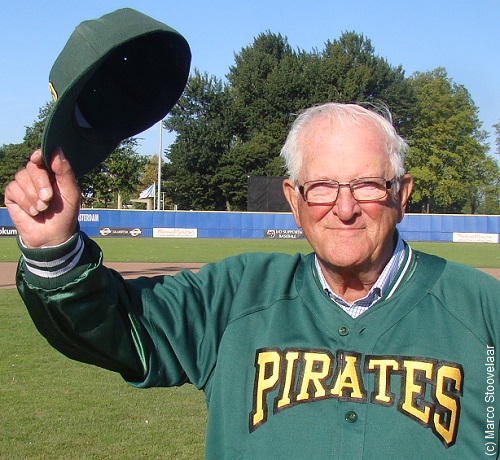
Loek Loevendie, the club icon of baseball and softball club Amsterdam Pirates with the highly deserved nickname Mr. Loevendie. Pirates, died on Saturday (Feb. 6) at the age of 88. Loevendie, who was and remained “Uncle Loek” to many, received many decorations and was a pioneer in the field of youth coaching.
Loek Loevendie was born on May 9, 1932, in Amsterdam. He is the younger brother of the also internationally known (jazz/opera/room music) composer and clarinetist Theo Loevendie, who turned 90 last year and is still active as a composer. From an early age, Loek Loevendie was interested in sports and began playing soccer and baseball himself.
On Feb. 17, 1959, along with Jaap van der Zee, Rinus Verschuur and Harry Meijers, Loek Loevendie founded a baseball team at soccer club Rap. It was the second time this Amsterdam club had a baseball section. The first was founded in 1937, but disbanded in 1946, as the club had unfortunately lost several club members during World War II and could no longer assemble a team. Ten years after the new baseball department was established, Rap created a women’s softball department in 1969 and a men’s softball department was added in 1974. After separating from soccer club Rap in 1974, the baseball and softball divisions formed an independent association and the name was changed to Amsterdam Pirates.
When Rap’s baseball team first competed in a league in 1959, Loek Loevendie was one of the players. Later, he also became one of the team’s coaches, as did Jaap van der Zee. At the same time, he also remained active training youth soccer teams, something he had been doing since the late 1940s. In the early 1960s, Loevendie, now very active in the baseball department, switched his attention from training youth soccer players to coaching young baseball players. A few years later, Loevendie began what became his famous Wednesday afternoon workouts for baseball youth. Toward the end of the 1960s, he had ads placed in weekly newspapers, which immediately generated a huge response and applications. With this, the youth division of Rap baseball began to take shape. It was the beginning of a particularly successful youth division that won many Amsterdam, regional and national titles. The successes of the youth department continue.
In 1963, the 14- to 16-year-old youth team became the first to become national champions. At the time, this team played in the so-called MC Bakker division, named after Dutch baseball pioneer M.C. (Maarten) Bakker.
Since the late 1960s through the 1970s, Rap/Pirates had a very active youth section. The youngest team (pupils, ages 8-12) participated in many (international) tournaments throughout the country. During those years, this team played in the Bleesing league, named after another Dutch baseball pioneer and longtime Federal President Emile Bleesing. It even happened that a team traveled from one tournament to another on the same day to come out in the Finals. And then win those. Regularly, one of the first questions Loevendie asked the moment he entered a playing field for a tournament was, ”How big is the cup for first prize?” This was often followed by the following announcement: ”We’re just here to win that one.” Starting in 1976, the club also participated in the annual baseball tournament at the U.S. Air Force Base Ramstein (Germany). Since the club went on its own feet, Amsterdam Pirates itself began to organize international youth tournaments on such days as Queen’s Day (April 30). Loek Loevendie was not only one of the organizers, but more so he was one of the coaches of the participating Pirates teams.
That the club became (and remained) successful from the late 1960s through the 1970s was due to the fact that Rap/Pirates had a very active youth committee, as well as having dedicated and passionate youth coaches. Besides Loek Loevendie, they included Paul Hamstra, Wim Joost, Herman Koot, Coen Stoovelaar, Kees van Vegten, Wim van der Poel, Herman Spilker and Nico Meijers. Together with these coaches, Uncle Loek formed the basis for Pirates’ successful youth department, as it still exists today.
Loek Loevendie always traveled to and from the field on his moped (later a scooter). From home or directly after work. Just to be with his club and his players every day. Over the years, Loevendie coached and mentored over a thousand young players in the club’s youth program. Of this group, over one hundred reached the big league. Many also played for the Amsterdam Rayon teams, which were assembled in these years and played against each other in the Rayon tournaments of the time. Several players reached the Dutch Youth Teams or played on the Dutch Baseball Team. The youth teams that Loevendie oversaw in the late 1960s/early 1970s featured players such as Marcel Joost, Frank Koot, Haitze de Vries, Jan Hijzelendoorn, Ronald Stoovelaar, Marten Walsma, Peter van Erk, Hans Jansen, Harm Schildmeijer, Martin van der Steeg, André van Beest and Laurens van der Poel, all of whom would reach the big league. The first six also played on the Dutch Baseball Team.
In subsequent years, other players who had started their careers in the Pirates youth academy also reached the Dutch Team. Many of them played for Loevendie in pupils or received necessary advice from him. Among them were Peter Boon, Jeffrey Cranston, Martijn Faneyte, René van Huffel, Patrick de Lange, Byron Ward, Jesse Aussems, Rashid Gerard, Zaïr Koeiman, Bas Nooij and Pim Walsma. Loevendie also trained and coached his own sons Loek Jr. and Marco. As a pitcher, the latter also pitched in the big league and in the Young Orange.
His young talents included players who would later go on to play professionally, such as Rikkert Faneyte, who would play in the Major League for San Francisco Giants and Texas Rangers. Players such as pitcher Tonny Cohen, infielder Raymond Hofer and pitcher Tom de Blok would also go on to play professional baseball in the USA.
His pupils in the 1990s included Johnny and Mariekson Gregorius. Their father Didi was a pitcher on Amsterdam Pirates’ big league baseball team and mother Sheritsa played on the softball team that also competed in the top division. In later years, after the family returned to Curaçao, Mariekson developed himself not only into a very talented baseball player, but also into a Major League shortstop. Mariekson adopted the nickname Didi from his father and played in the Major League for Cincinnati Reds, Arizona Diamondbacks, New York Yankees and Philadelphia Phillies.
Loek Loevendie had an eye for talent and detail. He saw right away when someone had something extra, and often he would give extra training. For many of these players, as well as many other club members, Loevendie was simply Uncle Loek and often remained so.
Not only the youth department was successful in the 1970s. Flagships in both baseball and softball also regularly finished at the top of their respective divisions. In 1981, the baseball team promoted to the big league. The softballers also promoted to the top division. Six years later, a dream came true when Amsterdam Pirates defeated Neptunus in the Holland Series and became national champions for the first time in club history. Loek Loevendie was among the first on the field with tears in his eyes to celebrate with the team and to congratulate the players, many of whom had played for him on youth teams.
In 1982 the club opened a brand new clubhouse with a beautiful terrace, which stood behind the right field and thus offered a magnificent view of the entire field. The foundation stone for the new building was laid (of course) by Loek Loevendie.
After the 2000 season, the club moved from its old location on Jan van Galenstraat to its current home at Sportpark ‘Ookmeer’. There the club was given more space, with two full-sized major league baseball fields, a major league softball field and a youth field. But the club also got its own sports hall.
A few years later, Loevendie established his own baseball and softball museum, which overlooks the field in the gymnasium. Many props and photos from Pirates history are on display here. But also from baseball history in general. In setting up and decorating the museum and compiling all the items, Loevendie received a lot of help from Ger Lange, who today oversees the museum.
On Sunday afternoon, Sept. 29, 2013, Loek Loevendie put an end to his active career as a youth coach. On this day, he last coached a cadet team of Amsterdam Pirates in a game against Tex Town Tigers from Enschede. Before the start of the game, Loevendie threw the ceremonial first ball. His coaching career spanned a period of no less than 65 years beginning in 1948 when he began coaching youth soccer teams at Rap at the age of 16. For the last fifty years, he coached youth baseball teams, something he always enjoyed most. After his last match, Loevendie said, “I would have liked to have continued, but my back just hurts too much. It’s time to stop coaching. But I just keep being active for the club, you know. I still have many things I am and remain involved with, such as the youth committee, materials, the museum and much more. And, of course, I will continue with the Wednesday afternoon workouts. Then I just sit on a chair and throw the balls to the batter. I love coaching youth and helping them get better. I still have plenty to do”.
And indeed Loevendie continued to oversee his famous Wednesday afternoon workouts. Until a few years ago when health problems forced him to stop doing so. Despite these physical complaints, he obviously kept coming to the Pirates field as often as possible, because he didn’t want to miss anything. And he was always present whenever the club’s big league team played on its own field.
In addition to coaching youth teams at Rap/Amsterdam Pirates, Loevendie was also game secretary for youth baseball within the club for several years. He began doing so in the late 1960s and continued to do so until the early 1970s. A few years later, until sometime in the early 1990s, he was again game secretary, but then only for the senior baseball teams, as Kees van Vegten had then taken over the youth game secretary position. Several times during this period, Loevendie quit this paperwork, but then returned a few years later.
Loevendie was also involved in the care of the playing fields, placed the lines for many years and was also groundskeeper. In the 1970s through the 1990s, he was also a consul to whom opponents could go to ask if a field was playable if it had rained, for example. In the early years, he shared this position with Doon van der Steeg.
Loek Loevendie also briefly served on the Amsterdam Pirates club board and was president for about two years in the early 1970s. However, he argued that he was not cut out to be a club director. He always said, ”I’m not a driver, I’m someone who wants to do things, be on the field, coach youth players.” However, he was a member of the association’s youth committee for many years until a few years ago. In that, he was more in place because he was then closely involved in what he loved most, training youth and sharing his ideas. After he stepped down as president, but especially for his many contributions in previous years, Loevendie was named an Honorary Member of the club.
In 1970-1974, Loevendie was also the secretary of the Youth Committee of the then Rayon Amsterdam. Other members of this committee included Bertus Caldenhove, Dolf Davidson, Miel van Heuven, Wim Joost, Joke Lammen, Benno Niemeijer, Dick Pels, Wim van der Poel, Roel Post, Coen Stoovelaar and Victor van Swede. Loevendie was an alternate Federal Council delegate for teams from the Main and First Leagues (1974-1975) and for Rayon associations from Amsterdam (1983-1989).
Over the years, Loek Loevendie received several awards for his activities.
At the Federal Council meeting of the Royal Dutch Baseball and Softball Association (KNBSB) on Feb. 28, 1976, the Slugger was awarded to Loevendie. The Slugger is the highest award of the Dutch Federation for individuals/organizations that have made a significant contribution in the field of promotion for the sport of baseball and softball in the Netherlands in the previous year(s). Loevendie received the Slugger because he had been involved with youth baseball for many years and took a special interest in the practice of the game by the very young. For this age group (starting at 4, 5 years old), Loevendie set out game rules for a game format before they would eventually start playing real baseball. Loevendie’s ideas were then developed by a larger group of people, leading to the creation of peanut ball.
In 1983, Loevendie was named Member of Merit of the then Rayon Amsterdam for his many activities in youth baseball.
A few years later, Loevendie received a special ring from the Amsterdam newspaper
Het Parool
. At the time, this ring was regularly awarded to individuals who showed merit in a variety of fields, including sports.
For his many years of activities in many areas within the Rap/Amsterdam Pirates association, including coaching youth teams, as well as promoting the sport of baseball and softball and much more, Loek Loevendie received a Royal Decoration on April 29, 2004. On that day, he was named a Member in the Order of Orange-Nassau.
On Oct. 4, 2014, Loek Loevendie became the newest member of the Dutch Baseball and Softball Museum’s Hall of Fame. On this day, he was officially inducted into the Honor Row before the start of Game 4 of the Holland Series between L&D Amsterdam Pirates and DOOR Neptunus at Sportpark ‘Ookmeer’, Pirates’ home field. Loevendie’s plaque was unveiled at a meeting in the clubhouse, after which he was honored before the start of the match. He became the 49th Hall of Fame resident and the first since 2009.
In December 2014, Amsterdam Pirates hosted the first international indoor youth baseball tournament in its own sports hall. In recognition of his longtime contributions to youth training within the association, the tournament was named after Loek Loevendie. The Great Ome Loek International Indoor Christmas Baseball Tournament became an instant success and drew many spectators. In 2018, tournament organizers Pepijn Beerman and Byron Ward (both former Loevendie youth players) led the fifth edition. Last December, unfortunately, the seventh edition could not take place due to corona measures. Of course, Loek Loevendie was always present in person to watch the young teams (pupil-age) in action, sitting on a throne made especially for him. Due to health problems, he attended only one day in 2018 and 2019.
On June 2, 2016, at Amsterdam’s Stadsschouwburg, Loek Loevendie was awarded the Penning van de Sportraad Amsterdam. This award is presented to a person or institution/association that has made a major contribution to sport in Amsterdam through daring, vision, ambition and commitment. The jury wrote that it “praised Loevendie’s years of activity with Baseball and Softball Association Amsterdam Pirates and his many contributions to the development of both sports in Amsterdam. In his acceptance speech, Loevendie said, “I had a great time at Pirates as a coach. I still enjoy giving BeeBall training to the very young every Wednesday. It’s hard to get out of the sport”.
In February 2019, Amsterdam Pirates celebrated its 60th anniversary. On Saturday, May 18, it was a special afternoon at Sportpark ‘Ookmeer’ where both the first baseball and softball teams played at home against Hoofddorp Pioniers and UVV, respectively. A ceremony before the games began officially commemorated the club’s 60th anniversary. During this ceremony, the new name of Amsterdam Pirates’ baseball and softball complex was unveiled: Loek Loevendie Ballpark. This was followed by a memorable first-ball ceremony, which was attended by Ronald Stoovelaar and Judith van Erk, who were the first to represent Amsterdam Pirates in the Dutch Baseball and Dutch Softball Team. Stoovelaar was one of many youth players who played for Loevendie on the then Bleesing (pupils) team. Ronald Stoovelaar caught the ball thrown by former Pirates Head Coach Charles Urbanus, while Judith van Erk threw a softball to former teammate Evelien Bode, who had reached Orange as Pirates’ second youth player.
The 2019 season ended with a huge success, as the L&D Amsterdam Pirates baseball team made history in the Holland Series against Curaçao Neptunus. The team lost the first three games, but then staged a spectacular comeback and became the first team in history to win the next four games with a 3-0 deficit to become national champions. Uncle Loek was able to celebrate this title himself. Also in 2019, the women’s softball team promoted to return to the top division in 2020.
From the beginning in 1959, Loevendie was on the field almost daily. He enjoyed being at his club’s complex and being with others, talking with his many baseball and softball friends or playing cards.
Loevendie could not sit still; he was always working on something. Whether that was coaching, giving instructions, collecting scrap paper, working in the cafeteria, preparing fields, expanding his museum or watching games. In later years, he also enjoyed attending games, watching from his own seat and looking around proudly. How “his” Pirates had grown into one of the leading clubs in the Netherlands. And thinking back on all the successes over the years of those youth teams and all those youth players he had coached.
Loek Loevendie was and will forever remain not only a club icon, but also “Mr. Pirates. We are going to miss him tremendously.
Bye Uncle Loek, rest in peace.
The board of Baseball Week Haarlem condoles Loek’s wife Riet, his sons Loek junior and Marco and other family and wishes them much strength with this enormous loss.
(Feb. 6)
Text: Marco Stoovelaar
Source: Grand Slam * Stats & News
© Photo: Marco Stoovelaar