




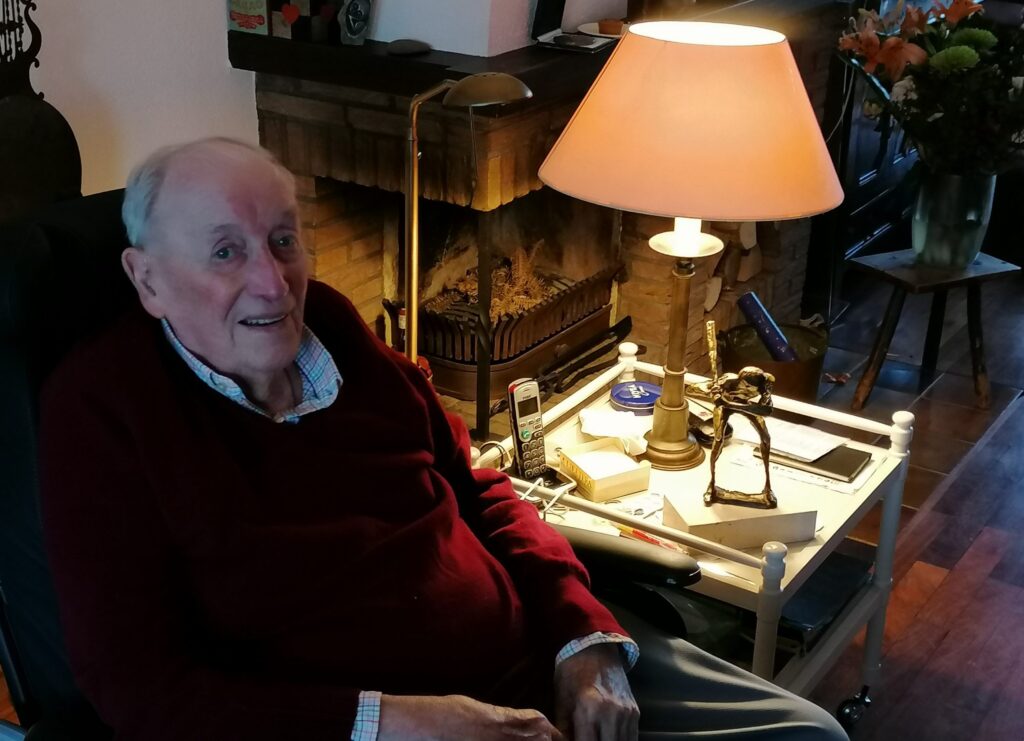
‘In order to tell about that first Haarlem Baseball Week, we must first take a little run-up.’ With these words, former Baseball Week president Wim Oosterhof begins at his home in Haarlem, a stone’s throw from the Pim Mulier Stadium. We go back to 1956, when the Dutch baseball team participated in an international baseball tournament for the first time. The players were initially received like royalty in Rome. That changed when those newcomers suddenly turned out to be formidable competitors.
Indeed, the Dutch team was even too strong for their hosts and they were not thanked for that. Oosterhoff was there in Italy at the time and reflects with a smile on how the mood turned. ‘We were suddenly not allowed to use the same facilities. Then the Italians refused to come to Haarlem for the first Baseball Weeks, because they didn’t want to expose the balance of power too much.’
Thanks to the efforts of Wout Posthema, the then new president of the KNHB, the baseball circus landed in Amsterdam two years after the European Championships in Rome. ‘Baseball was fortunate that people like Bob Spaak and Dick van Rijn, at that time the most popular sportscasters in the country, were enthusiastic about the sport. The final of the ’58 European Championship was even broadcast live on television.’ It is not only through television that baseball operations are closely followed. The stands during the tournament are also packed with people who want to see the spectacle up close. It was thanks to KNHB President Posthema that those stands and the baseball field could be built. He managed to get OVVO’s soccer fields made available and quickly made playable again for soccer after the tournament.
After four consecutive European titles – because in between, the Orange also proved themselves the best in Mannheim (’57) and Barcelona (’59) – the Dutch team seemed to have outgrown its own continent. With the successful organization of the European Championship at home still fresh in the memory, there was an increasingly strong need for a regular international tournament on Dutch soil. In 1961, out of that desire came the first edition of the Haarlem Baseball Week.
So although the EC was held in Amsterdam, Haarlem was the undisputed baseball capital of the country at the time. The city had no fewer than five baseball associations, so it seemed like the most fertile place to create an international tournament. ‘At the time, Gé Hoogenbos pulled out all the stops to bring the tournament to Haarlem,’ Oosterhof recalled. ‘A few aldermen were also keen on an international sports tournament in Haarlem, but the organization had to be in the hands of an experienced committee. That’s how they came to us as the board of the annual Haarlem Sports Weeks.
Money was not there at the time. The arrows were aimed at American soldiers stationed in the countries surrounding us after World War II. Ron Fraser, the American coach of the Dutch team, had been military in West Germany and had gained contacts throughout Europe as a result. Teams traveled to Haarlem from Chateauroux (France), Alconbury and London (England), Wiesbaden and Mannheim (West Germany) for that first Baseball Week.
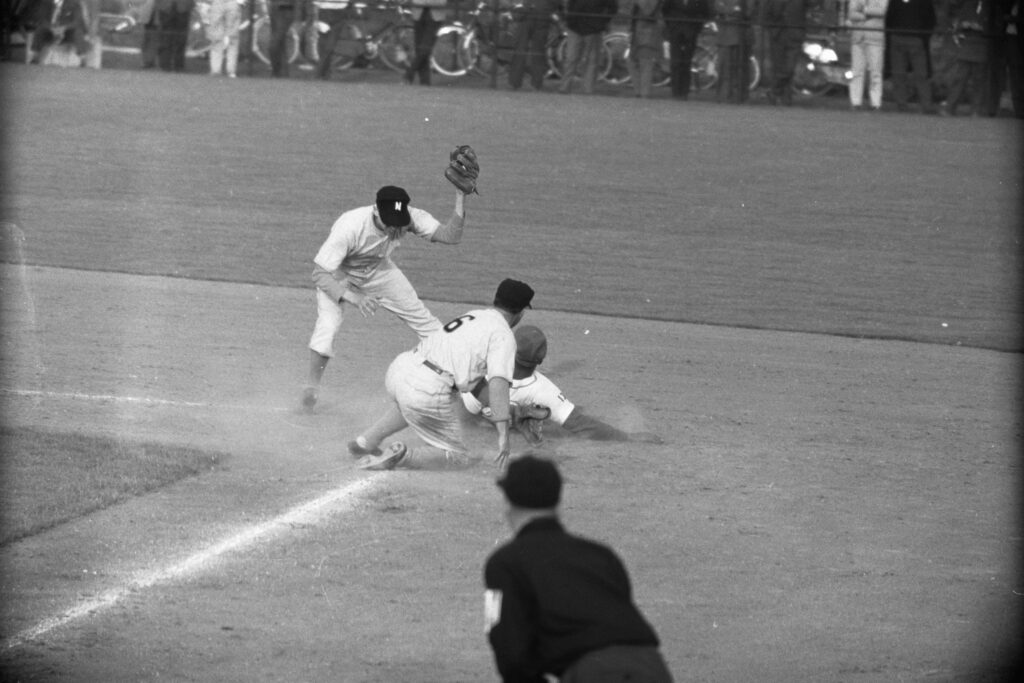
The Americans appeared to be cut from a different cloth than the European baseball players from whom the Dutch team won so easily in recent years. The Dutch formation, coming out that first edition under the name Kieviten because the league did not allow them to compete as a national team, finished fifth out of six. Only the team from London managed to keep them behind that year. Still, this first baseball week was a great success. The audience descended on the fest in large numbers and feasted their eyes. The field play and athletic ability of the Americans impressed greatly.
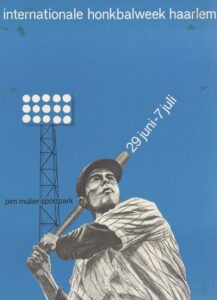
For the second edition two years later, the tournament moves from the makeshift field on Badminton Path to the newly constructed Pim Mulier Stadium. ‘[Aannemersbedrijf] Nelissen got that stadium out of the ground in 88 days.’ It is the first baseball stadium in Europe. The new facility also has a real light installation, so that baseball can now be played in artificial light at night. The tournament had received an accommodation worthy of the event.
Looking back on those early days, the name of Bob Sullivan, furniture millionaire from Grand Rapids, Michigan, quickly falls to mind. ‘Sullivan was a real baseball fan. He helped the organization out quite a bit in the later years. If teams canceled shortly beforehand, we could always call him.’ Especially when in ’78 the Cubans cancelled just before the start of the tournament, people in Haarlem were at a loss. A phone call to Sullivan offers relief. He throws around plans and sends his team on the first plane to Holland.
Oosterhof also holds fond memories of the guest tent. ‘Mother Weijland, who did the catering at Haarlem Nicols, used to butter the sandwiches there. Then you always got a slice of gingerbread with it. In that one tent the coaches, referees, sponsors and authorities came together. That created a special bond. Now everyone sits in their own box. Gerard Voogd was the organizational big man from the beginning. He brought in both teams and sponsors. In those days many hot shots came to Haarlem. Top people from Philips and Coca-Cola were only too happy to associate themselves with the tournament.’
Oosterhof also met the love of his life thanks to Baseball Week. During the preparations for the second edition, some concerned aldermen relinquished their secretaries to the organization. One of those secretaries was Hennie to whom Wim has now been married for more than fifty years. Where during their first collaboration was merely a friendship, something beautiful blossomed during their second collaboration a few years later.
Suddenly Wim, who until that time had always come by car to the meetings at Gerard Voogd’s home, came on his bicycle so that he could ride up with Hennie.
Text: Sander Grasman