





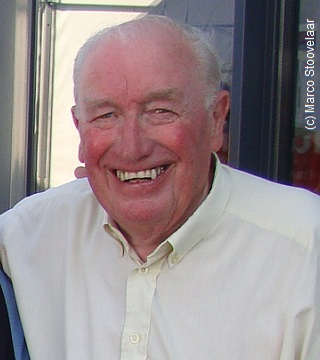
HAARLEM – Wim Oosterhof, who was active in baseball and/or softball for eighty years, died on Tuesday night (May 4) at the age of 93. Over the years, Mr. Oosterhof held many positions within his club Kinheim, was one of the club icons and can rightly be called “Mr. Kinheim. Wim Oosterhof was inducted into the Dutch Baseball and Softball Hall of Fame in 2008.
It is unfortunately another sad time for the Dutch baseball and softball community. Last Thursday (April 29), former Official Scorer and league official in Rayon Amsterdam Fiet Aussen passed away at the age of 92. On Tuesday morning, former KNBSB board member and former European Softball Federation (ESF) President André van Overbeek passed away at the age of 71.
Wim Oosterhof was born on Jan. 7, 1928, in Bloemendaal. Where to start when talking about Wim Oosterhof? He can rightly be called a jack-of-all-trades. Wim Oosterhof was a pioneer for Dutch softball, was a board member of his association HCK (Kinheim), the Royal Dutch Baseball Association (KNHB), the Dutch Amateur Softball Association (NASB), the Royal Dutch Baseball and Softball Association (KNBSB), the European Softball Federation (ESF) and De Kieviten. Within the city of Haarlem, he still held many volunteer positions in some twenty organizations and foundations. Wim was always busy and took great pleasure in his administrative and organizational activities. Talking and writing about Wim Oosterhof is a journey of reminiscing about the rich past of baseball and softball in our country, as he worked with many well-known personalities in our history. Although there are 24 hours in a day, Wim Oosterhof must have found extra hours somewhere when you look at long list of things he has done over the years.
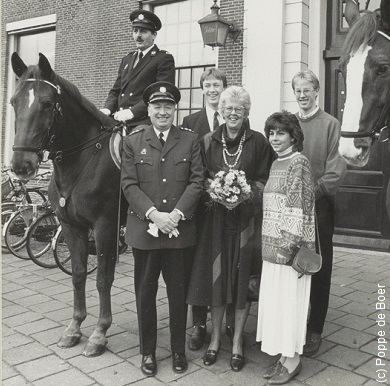 After his military service, Wim Oosterhof worked for a year (May 1950-May 1951) in Indonesia, which had gained independence shortly before after being known as the Dutch East Indies since 1816. In Indonesia, he was stationed in capital Djakarta and helped hand over equipment and parts from the Dutch army to the Indonesian army.
After returning to the Netherlands, Oosterhof enrolled in police training in Hilversum in September 1951. After successfully completing the course two years later, he initially worked in The Hague. In 1955, he became an inspector of police in his hometown of Haarlem. That was the beginning of a long career with the Haarlem Police Department. In 1981-1988, Wim Oosterhof was Police Commissioner in Haarlem and also acting Chief of Police. When he stepped down in January 1988, the national police force was redistributed into several new regions. Then Haarlem Mayor Elizabeth Schmitz asked Oosterhof to continue as regional coordinator for two more years, which he did.
Wim’s athletic career began sometime in 1942 when he began playing baseball at HCK, which stands for Baseball Club Kinheim. Founded in 1935, Kinheim is one of the oldest clubs in the Netherlands. The club named after the Kinheim Park, which was located in Bloemendaal just across the Haarlem border. Also in the 1940s, he played soccer at BVC Bloemendaal, which in later years also gained a successful baseball and softball division. In 1949, Oosterhof became secretary at Bloemendaal. A longtime board member with this association was Gerard Voogd with whom Wim would work for many years. A short time later he became a board member of Kinheim, the association of which he would be a member for eighty years! In all these years Wim Oosterhof fulfills all kinds of functions and activities within the association, moving from Bloemendaal to different locations and finally ending up at their most famous spot on Badmintonpad. The Municipal Sports Park is located there, and the baseball field is used by several clubs, including HCK. In later years, HCK becomes the sole occupant of this intimate and cozy complex with its baseball and softball teams. In 1973, the association opened a clubhouse. That became the location of many long after-dinner discussions over drinks in the “pit” at the bar. Kinheim developed itself into a successful association. Not only with baseball, but also with the softball department, which was founded in 1948. It was Joop van Wendel de Joode and player/coach Bep van Beijmerwerdt who played important roles in the softball department. Other very active individuals within HCK since these years included Paul Paul, Arie van Driel Krol, Dries de Zwaan and Cor Zandstra.
Wim Oosterhof held a variety of positions at HCK, including managing the match secretariat. He became president in the spring of 1956 and led the association for many years thereafter. HCK (Kinheim) has always had close foreign contacts. In the years following World War II, the association organized matches against American soldiers stationed in what was then West Germany. That led to annual games against Wiesbaden Flyers. That team was led by renowned coach Chuck Costello, who was instrumental in bringing U.S. military teams from Europe to the Haarlem Baseball Week field of participants in the 1960s. The Kinheim softball players played several games against teams from Springfield College from the USA. Wim Oosterhof was one of the HCK officials who oversaw these international contacts.
Beginning in the 1970s, American players regularly played on Kinheim’s baseball team, which also had several American coaches. Some of these players stayed at the home of the Oosterhof family, who were always very hospitable. When famed American coach Bill Arce and his wife Nancy visited Holland, they stayed with the Oosterhof family in Haarlem. So Wim Oosterhof always tried to stay in contact with foreign players and guests for as long as possible. Similarly, Wim and his wife Hennie stayed in touch with former player Bep van Beijmerwerdt after she emigrated to America in the 1960s. Bill Arce died in 2016, Bep van Beijmerwerdt in 2019.
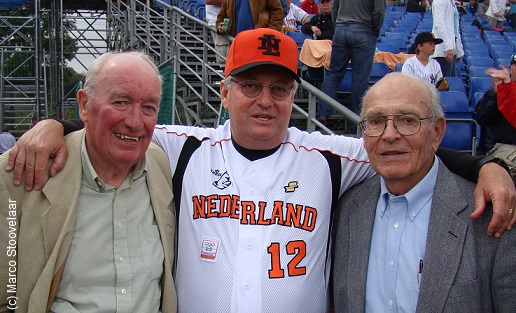 After the successful European Baseball Championship in 1958, organized in Amsterdam, it was Gé Hoogenbos, who felt that the time was ripe for a major international tournament. Hoogenbos played for the Haarlem HHC (and later EHS) and proposed the idea to the Haarlem City Council, which immediately showed interest. Hoogenbos was inventive and always brimming with ideas to promote the sport of baseball and wrote about baseball in The Telegraph. In the 1960s, it was through Hoogenbos that a merger between EHS and EDO occurred, leading to the formation of Haarlem Nicols.
In 1961, it was Haarlem alderman for sports Daaf Geluk who played an important role in the realization of the first International Baseball Tournament in Haarlem. Already during the event, the name Haarlem Baseball Week was introduced. And that was the beginning of the long history of this international tournament held every two years.
Wim Oosterhof was involved in organizing the tournament from the beginning. The first tournament took place at the Municipal Sports Ground on Badminton Path. That was being used by several clubs at the time, including Oosterhof’s club HCK. Two years later, Pim Mulier Stadium opened, just in time for the second tournament. This stadium is still the site of Baseball Week and is also currently the home of Kinheim. Starting in 1961, Oosterhof was an active or spectator at all of the Haarlem Baseball Weeks organized through 2018. Last year’s 30th edition had to be canceled due to the coronavirus (COVID-19). This edition is now scheduled for 2022.
Within the Organizing Committee, Oosterhof’s responsibilities included accommodation, as well as liaison with the municipality. He had many conversations with the sports councilors, including the aforementioned Daaf Geluk and, in later years, Piet Voskuilen and Ab van Schooten. These discussions, plus Gé Hoogenbos’ plans, led to the construction of the baseball stadium in 1962-1963. At the time, that was the very first baseball stadium in Europe, complete with bleachers, a light installation and a scoreboard. In later years, the light poles were renewed, the outfield fence moved to the rear and a new electronic scoreboard put into service.
After the successful first editions, the Organizing Committee had to make decisions about the participating teams. The playing quality of the Dutch Baseball Team increased and got better and better. Starting with the second edition, semi-professional teams Sullivans and California Stags from the USA became regular participants. In later years, the National Teams of the Netherlands Antilles and Italy were invited, as were stronger American college teams. Another highlight came in 1972 when the strong teams of world champions Cuba and Nicaragua came to Haarlem for the first time.
In addition to inviting strong teams, the Organizing Committee also set itself the goal of keeping the atmosphere in the stadium and around the games among the spectators good and cozy. Over the years, Baseball Week became known for the enthusiastic and exuberant behavior of the thousands of spectators who enjoyed the games. Members of the Organizing Committee have also always remained approachable to everyone.
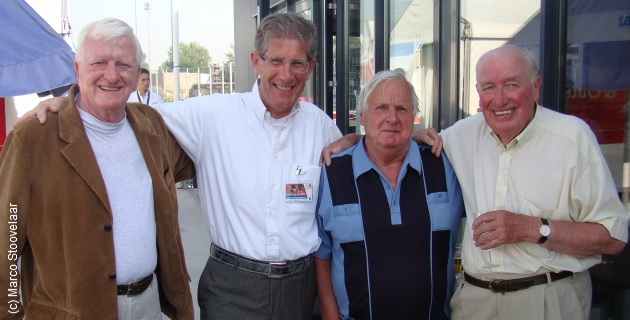 In 1963, Hennie Kooij took care of the administrative work in the so-called permanence during the second Baseball Week and later married Wim Oosterhof. Hennie Oosterhof continued to work in the permance until the early 1980s as, among other things, tournament secretary. Like her husband, Hennie is also very active and, from the late 1970s until the 1980s, was a member of the KNBSB Training and Examinations Committee, among other things.
Wim and Hennie Oosterhof’s sons, Willem junior and Onno also play baseball for Kinheim. Willem junior plays some time on the main team in the big league. He is still active for the club as he is the treasurer of the Friends Kinheim Foundation with Toine Jager as chairman and Kees Tromp as secretary. Toine’s father Peter Jager also served as association president for many years. Trump was secretary for many years and was the dugout scorer for the baseball team for some 20 years.
Wim Oosterhof served on the Organizing Committee during the first seven editions of the Haarlem Baseball Week (1961-1972). Other organization members in those years included Gerard Voogd (chairman), Wout Posthuma, Piet van Deenen, Martin Bremer, Karel de Graaf, Jan Hartog, Hans de Bie, Henk de Bruin and Jan Visser. In 1972, new board members included Dries de Zwaan and Gonny Wedemeijer.
Although he was no longer part of the organizing board after 1972, Wim Oosterhof remained active for the tournament, for many years he remained, among other things, the contact person between the organizations and the municipal authorities and remained involved in the international contacts.
In 1962, Oosterhof was also part of the Organizing Committee when the European Baseball Championships were again organized at the OVVO complex in Amsterdam. He was also involved in the organization when this event was held in Haarlem in 1973, 1977, 1981 and 1985.
When the first Haarlem Softball Week was organized in 1980, Wim Oosterhof was also involved there. Not as a member of the organization, but he supported the board with his contacts within the congregation.
In the early 1980s, the Netherlands was awarded the organization for the World Baseball Championship, which was realized in 1986. In that year, matches of the global event will be played in Haarlem (main venue), Eindhoven, Rotterdam and Utrecht. Amsterdam is the central city where the teams and officials reside and is also the main press center. In 1984-1987, Wim Oosterhof was the vice president of the World Baseball Championship Foundation ’86. The other members are Guus van der Heijden (president), Piet Tromp, Theo Vleeshhouwer, Gerard Voogd, Dries de Zwaan and Aad van der Elst. Because of their experience, the Organizing Committee is much the same as that of the Haarlem Baseball Week. Trump is its president and Oosterhof organization member.
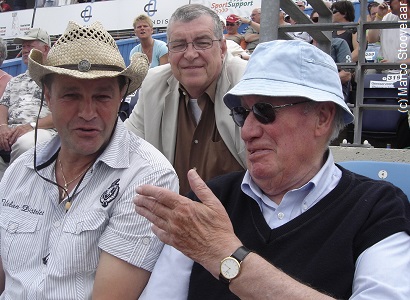 After the World Championships, Trump will quit as president. After this, Wim Oosterhof returns once more to the Organizing Committee, as he is the chairman during the 1998 edition of the Haarlem Baseball Week. The other organization members that year were Jaco van Ekeris, Aad van der Elst, Jan van Gennip, Theo Vleeshhouwer, Rob Spies, Peter Laanen and Jacques Reuvers. In 1989, Oosterhof was succeeded as president by Piet Sikma, the former sports alderman of Haarlem. Sikma leads the tournament in 1990 with Reuvers as vice president, who takes over during Baseball Week 1992.
Wim Oosterhof developed his administrative and organizational skills at an early age. As mentioned above, he was board secretary of BVC Bloemendaal in 1949 and shortly thereafter became a board member at HCK (Kinheim). His qualities were noticed and in 1958, only 29 years old, Wim Oosterhof became the new secretary of the Federal Board of the Royal Dutch Baseball Association (KNHB). At that time, Arie van Driel Krol, another HCK club icon, was the vice president. Also new that year is chairman Wout Posthuma as successor to Dick Beets. Through 1960, Oosterhof is the secretary of the KNHB board, which in these years also includes Wout Posthuma (chairman), Arie van Driel Krol (vice-chairman), Jan Hartog (second secretary), Ab Hordijk (treasurer), Hans Boersma (second treasurer) and Lou Fisser (member). In 1960, Ko Scheen succeeded Van Driel Krol, and Jan Sibille succeeded Hordijk.
During these years, Oosterhof also served on a number of KNHB committees. In 1958-1960, he is the secretary of the Disputes Committee along with Wout Posthuma and Ab Hordijk. In 1958, he chaired the Rules Committee with Henk de Ruiter as secretary and Dick Baas as a member. And in 1958-1959, Oosterhof is the secretary of the Grounds Committee with Hordijk as chairman.
In early 1961, Martin Bremer succeeded Wim Oosterhof, who then began a new administrative chapter, as he became active for the Dutch Amateur Softball Association (NASB), which was founded in 1951. At the time, Jules Kammeijer was the first president. Who introduced softball during World War II as a baseball variant for women. Other early Softball Association board members include players Riet Vermaat, Bep van Beijmerwerdt and Hannie Berendonk, as well as Gé Hoff Sr. (president) and Teun Gaartman (vice president).
In March 1963, Dries de Zwaan became the new treasurer of the Softball Association. Like Oosterhof, De Zwaan has been particularly active for HCK, fulfilling many roles over the years, including internationally. Oosterhof and De Zwaan did much work for the development of softball in our country. For many years, De Zwaan also wrote extensively about softball in the Haarlems Dagblad newspaper.
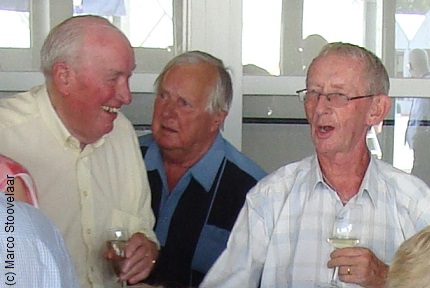 A year after De Zwaan joins the NASB board, Wim Oosterhof becomes president, a position he holds through 1970. In addition to Oosterhof and De Zwaan, other board members in those years included Teun Gaartman, Piet Gabes, Janke Nijdam, Gé Hogenbirk, Line Klein-Desta and Herman Kruijt. In 1969, Marga de Ruiter became the new secretary. She and Oosterhof, plus the other board members in 1969 and 1970 held discussions with the Royal Dutch Baseball Association (KNHB), resulting in a merger in December 1970. On January 1, 1971, the new Royal Dutch Baseball and Softball Association (KNBSB) is presented.
Wim Oosterhof, Marga de Ruiter and Gé Hogenbirk were also part of the first KNBSB board with Lex van der Stek as chairman. The other members are Guus van der Heijden, Martin Bremer, Freek Bos, Dirk Molenaar, John Oosterbroek and Ton Pols. In 1972, Theo Vleeshhouwer succeeded Bremer and remained secretary of KNBSB for many years. A year later, Van der Heijden became the new president, which also marked the beginning of a period. In early 1974, Oosterhof was succeeded by Cees Boer Sr.
After the merger, Wim Oosterhof (as chairman) formed a committee for men’s softball with Marga de Ruiter and Cor Jonker. In 1971-1975, the new KNBSB had a special committee for international affairs. For the first three years, Oosterhof is secretary of this committee, which is chaired by Guus van der Heijden. The other members are Jan Hartog (baseball affairs) and Willem de Ruiter (softball affairs). In 1975, Oosterhof handles softball affairs on this committee, which then continues to consist of Van der Heijden, Gerard Voogd, Wil Soolsma and Jules de Pierre.
Wim Oosterhof is also an international director for some time. In 1970 and 1971, he was the vice president of the European Softball Federation (ESF), with Italian Bruno Beneck as president. This Union in the forerunner of today’s ESF, which was reconstituted in 1976 by representatives of Belgium, Germany, France, Italy, the Netherlands and Spain.
Wim Oosterhof is also a longtime board member of De Kieviten. This reunion association not only organizes gathering for members who have all made special contributions to baseball and softball, but also supports a variety of activities to promote both sports. In 1982-1998, Oosterhof served on the board, but in 1999 and 2000 he was the vice president. He then became a member again in 2001, after which he quit. But some time later he did return as vice president.
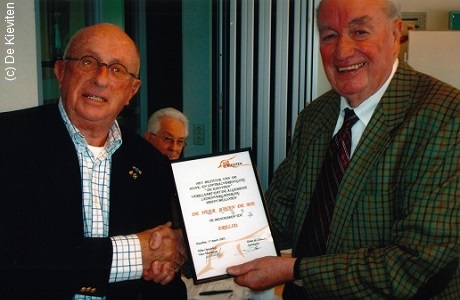 Other longtime De Kieviten board members in these years since Oosterhof’s arrival in 1982 include Johan de Bie (president), Theo Vleeshhouwer (vice president), Maartje Nierop Groot (secretary), Wim Ascherman (treasurer), Wim Endel (member) and Jan Meijer (member). From 1990, board members included Rob van Tuyl, Wim Broertjes, Tiny van der Poel, Piet van Rijswijk and Dries de Zwaan.
After his retirement from the Haarlem Police Department, Wim Oosterhof remains a busy person. He is active for the National Police Sports Association and holds many volunteer positions within various foundations in his beloved Haarlem. These include his involvement in the celebration of Haarlem’s 750th anniversary in 1995. Two years he is the project leader to celebrate this celebration.
Oosterhof is also active for Haarlem Promotion, which introduced the slogan “Haarlem Flower City.
Starting in the late 1990s, Wim Oosterhof has been active for about ten years for the Molen De Adriaan Foundation, which raises money for the rebuilding of the famous mill on the Spaarne River in Haarlem. Dries de Zwaan has also been closely involved with this Foundation for a long time. When Oosterhof bids farewell to this Foundation, the Wim Oosterhof Bank will be unveiled at the entrance.
Over the years, Kinheim has always been an ambitious club. In July 1967, Wim Oosterhof, then president of the club, was interviewed by Hans de Bie for BaseballBaseball magazine. Regarding these ambitions, Oosterhof said then: ,,I am convinced that every association should try to achieve the best performance by all appropriate means. At my association – as fortunately at all other associations – we have a certain atmosphere of our own. We continually strive to foster among our members an interest in and appreciation for each other, not just athletic qualities. Based on this, we try to impress upon the members that they should use their qualities as much as possible for the club, so that organizationally and athletically the most favorable result is achieved”.
At the time of the interview, Oosterhof is also president of the Dutch Softball Association. He enjoys both baseball and softball, but sees a growing future for softball. He said: “I am convinced that both sports will have to go hand in hand in spreading this genre of sports. In America, softball practitioners outnumber baseball practitioners, but baseball gets the most attention. Organized softball in our country is increasing quite slowly, but I believe that in the more recreational and training sphere softball is and will be practiced more than baseball”.
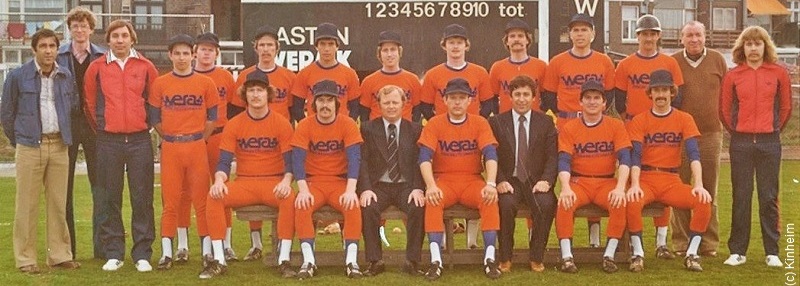
In 1978, a dream came true and the club’s ambitions became reality when Kinheim became national baseball champions for the first time in club history. Among players in that season are Hans Augustinus, Nol Beenders, Frank Breek, Hans van Driel Krol, Fokke Jelsma, Frank van der Putten and Ron Vader. Head Coach of the team is Karel Crouwel. This was the first of five Championships, as the team captured the title again in 1994, 2006, 2007 and 2012.
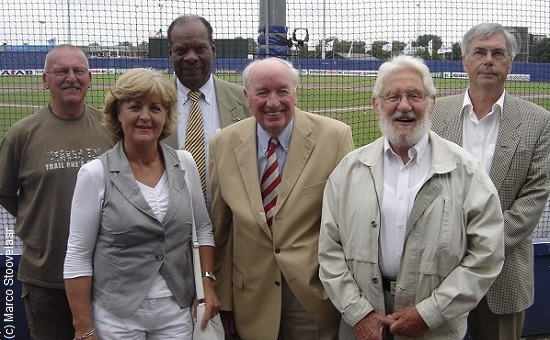 Wim Oosterhof is awarded several times for all his activities.
When he stepped down as a board member in 1974, Wim Oosterhof was named an Honorary Member of the Royal Dutch Baseball and Softball Association (KNBSB).
In 1996, he received the Honorary Medal of the City of Haarlem for his organization of the festivities surrounding Haarlem 750. The Honorary Medal is awarded to individuals based on administrative merit, but in later years was also awarded to individuals from the arts, culture and sports. The award has been presented to Haarlem mayors Oscar Cremers (1969), Jan Reehorst (1984), Elizabeth Schmitz (1994), Jaap Pop (2006) and Bernt Schneiders (2016), among others, as well as aldermen Daaf Geluk (1970), Piet Voskuilen (1978), Ab van Schooten (1990) and Piet Sikma (1990) and painter Kees Verwey (1985), Olympic skating champion Yvonne van Gennip (1988), filmmaker/artist Gerrit van Dijk (1998), author Louis Ferron (2002) and singer/songwriter Boudewijn de Groot (2011).
For his many activities at Kinheim, Wim Oosterhof was named Honorary President and Honorary Member. He was also named an Honorary Member of De Kieviten.
Another highlight came on July 27, 2008 when he was officially inducted into the Dutch Baseball and Softball Hall of Fame, along with Jules de Pierre. This ceremony then took place during the Haarlem Baseball Week.
In 2018, Kinheim hosted a baseball tournament in preparation for the new season. A year later, the association decided to name the tournament after Wim Oosterhof. Both last year and this year, unfortunately, the tournament had to be cancelled due to coronavirus measures.
Anyone who has met Wim and Hennie Oosterhof can confirm that they have always been extremely friendly, welcoming and interested. The two are much loved, not only within the Kinheim family, but also by others. As for the author of this story, I can say that I have had the pleasure of knowing both of them for 45 years. Hennie was the secretary of the Examination Committee when I took my exam as Official Scorer in 1977. Having already met Wim regularly at Kinheim, I worked with him for the first time during the 1988 Haarlem Baseball Week when he was chairman of the Organizing Committee and I was editor of the daily tournament magazine for the first time (Reading Feed). Whenever we ran into each other over the years there was always a chat and the friendship has always remained.
Unfortunately, in recent years Wim struggled with health problems and had to propel himself with a wheelchair. At he was always lovingly cared for by Hennie and the two attended Kinheim games as often as possible. And always they had a smile on their face and always remained positive.
Wim Oosterhof was a special and striking personality. A man with a long and impressive career in baseball and softball. Someone who enjoyed everything he did, but always remained humble about what he had done (or was doing) for sports, for Kinheim and for the city of Haarlem. One that will be missed by many.
The board and all volunteers of Baseball Week Haarlem extend their condolences to Wim’s wife Hennie, their sons Willem Jr. and Onno, grandchildren and further family and friends and wishes them much strength with this great loss.
The farewell ceremony for Wim Oosterhof, who was Officer in the Order of Orange-Nassau, will take place at 3:30 p.m. on Wednesday, May 12, at Afscheidshuis and Crematorium Sterrenheuvel in Haarlem. Due to current measures, this will be in a limited circle, but the service can be followed http://www.sterrenheuvel.nl/ via a live stream. The login code is 317502.
(Text: Marco Stoovelaar; Photos: North Holland Archive/Fotoburo de Boer/Poppe de Boer, Kinheim, De Kieviten & Marco Stoovelaar, Sander Grasman)